

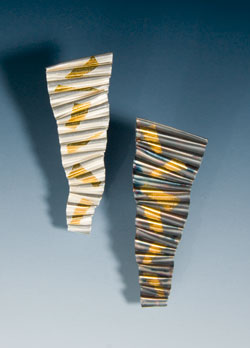
Working with Argentium® Sterling Silver is not so very different from working with traditional sterling silver. It is important, though, to know about the differences.
What is Special about Argentium Silver?
- Argentium® Sterling Silver is highly tarnish-resistant.
- Argentium® Sterling is more malleable and ductile than regular sterling silver.
- Argentium® Sterling can be hardened using a kitchen oven or toaster oven.
- Argentium® Sterling fuses, granulates, and welds well.
- Argentium® Sterling Silver does not firescale.
What is the composition of Argentium Silver?
To be Sterling Silver, an alloy needs to contain at least 92.5% silver. Argentium Silver more than meets that threshold, with both alloy variants containing at least 93.5% silver. The key difference is that Argentium Silver also contains approximately 1% Germanium, with the remainder of the alloy being comprised of copper.
It is interesting that more than ~1% germanium is not better, and that removing all the copper does not improve the alloy either. The copper offers strength; the germanium changes the working properties: tarnish resistance, no firescale, and transmitting heat differently.
Argentium 940 vs Argentium 935
As alluded to earlier, there are actually several Argentium Silver alloys. Today you will readily find Argentium 940 and Argentium 960, but prior to the early 2020s Argentium 935 was the de-facto Argentium Silver alloy. The numbers in each of those names refers to how much silver is in the alloy, measured in parts per thousand. (e.g. 935 = 93.5% silver, 940 = 94% silver, etc.)
Argentium 940 has more or less replaced Argentium 935; it was developed to have working properties that are more similar to traditional sterling silver. The shorter melting range makes AS 940 less fragile when red hot than AS 935. AS 940 can be quenched after annealing or soldering, and moved and poked during soldering. Sterling silver is fragile at the higher temperatures equivalent to fusing, and the same is true for AS 940. When it comes to fusing, which is nearer to melting temperatures, I suggest not moving, poking, or quenching neither AS940 nor sterling.
You can learn more about the difference between these two alloys on the Argentium Guild's website.
What is germanium?
Germanium (Ge) is an element similar to tin and silicon. It is a metalloid ─ not quite a metal. It is an important part of night vision goggles, and has antibiotic properties.
Firescale ─ what it is, and why it occurs
Silver is one of the few metals that allow oxygen to penetrate the surface. During annealing or soldering, oxygen attaches to the copper under the surface of traditional sterling silver (that’s firescale). This dark layer is under the surface of regular sterling silver, and does not come off in pickle. Firescale can be removed by polishing, strong acid, or electro-stripping. Firescale is often covered by electroplating or by depleting the copper from the surface through repeated heating and pickling (often called “depletion gilding” or “bringing up the fine silver”).
How does germanium prevent firescale?
Germanium is an “oxygen grabber.” Ge is more aggressive about grabbing oxygen than copper. The germanium combines with oxygen, to make Germanium oxide, GeO2. The germanium oxide prevents oxygen from penetrating the surface of the metal. Since oxygen cannot get inside the metal, Cu2O (firescale) cannot form. Argentium may discolor from soldering or annealing, but the discoloration is only on the surface, and it comes off in pickle.
If I’m not sure whether a piece of metal is traditional SS, or if it is AS, how can I tell which it is?
Here is how I test a piece of metal to find out if it truly is AS: first sand, scrape, tripoli, or otherwise abrade the surface to make sure there isn’t a fine-silver or germanium oxide surface coating. Then heat the metal with a SMALL torch flame, being sure to take the flame off the metal occasionally to let oxygen reach the metal. If the metal is traditional sterling, it will turn black and stay black. If the metal is Argentium, it may turn black, but as you keep gently heating, taking the torch on and off, the metal will turn pale gray. Traditional sterling stays black. It can be helpful to test a known piece of each alloy at the same time, to compare results.
How do I know whether a piece of metal is Fine Silver, or if it is Argentium Silver?
Fine silver does not discolor when annealed or melted.
What are the most important things to know about how Argentium Silver (AS) is different?
- AS does not transmit heat the way that SS does. Heat stays where the torch is aimed.
- Because the heat is not transferred so quickly, AS stays hot longer, and we need to wait longer before picking it up, or quenching it. It is cool enough when a drop of water on a pair of tweezers sizzles when touched to the hot metal.
- AS glows more dimly than SS when annealing. Use Sharpie as a temperature indicator. Annealing temperature has been reached when the Sharpie marks fade to a “ghost.”
- Rather than “heat the whole thing” the way we usually heat SS and copper alloys, heat the area that needs to get hot. Heat a long seam, or a large piece of metal area by area, sequentially.
- If heating is done using a charcoal block, then flux the entire top surface. When using any other sort of soldering board, you only need to flux a seam. Letting oxygen reach the surface creates germanium oxide, which increases the tarnish resistance.
- To maximize tarnish resistance, heat the AS after all finishing processes are done, but before setting stones. It is ideal to harden at the same time. Two to three hours at 450F works well. I use an open Pyrex dish in a toaster oven, kitchen oven, or kiln.
Learn More:
You can learn more about this alloy by reading the technical handouts created by renowned Argentium Silver specialist Cynthia Eid. They can be found here on her website.